Answer Engine Optimization helps your brand appear in AI-powered search answers. It boosts visibility and engagement. Also, AEO makes your content trusted and cited to stay ahead as search becomes conversational.
Search is rapidly changing. Especially generative AI tools like ChatGPT, Microsoft Copilot, Perplexity, Gemini, Meta AI, and Claude have become common ways for people to find information. As a result, traditional SEO alone is no longer enough to maintain visibility. Mainly, to address this shift, Answer Engine Optimization (AEO) helps brands get discovered and cited directly in AI-generated answers. Moreover, it focuses on being recognized by AI tools rather than just appearing in search results. If you wish to learn all about AEO, read this blog. Here, we have explained what AEO is, why it matters, how it works, the challenges involved, and the differences between AEO and SEO.
Answer Engine Optimization (AEO) is the process of making a brand more visible in AI-powered answer engines. These platforms usually provide direct answers to users’ questions. Unlike traditional Search Engine Optimization (SEO), AEO focuses on getting your content mentioned, cited, and featured in AI-generated responses.
In simple terms, AEO will help your content become the answer AI tools show when users ask questions like “What are the best restaurants in Texas?” rather than just appearing as a link in search results.
Both AEO and SEO aim to improve online visibility, but they are different in the way they work. Here, let us explore the simple comparison of AEO and SEO
| AEO | SEO |
| AEO will target AI-powered answer engines such as ChatGPT, Copilot, and Perplexity. | SEO will focus on traditional search engines like Google, Bing, and DuckDuckGo. |
| The main goal of AEO is to be cited as the answer in conversational AI responses. | SEO will aim to rank for keywords to drive organic traffic. |
| AEO will measure success through mentions, citations, placements, and referral traffic. | SEO will measure success with rankings, impressions, domain authority, and clicks. |
| Users interact with AEO by asking conversational questions, such as “Who invented X?” | Users interact with SEO through keyword searches, like “history of invention.” |
| AEO will provide direct responses and concise explanations. | SEO will provide links to web pages and listings in search results. |
| AEO strategies will deal with structured answers, schema markup, and authoritative content. | SEO strategies will focus on keyword research, backlinks, and on-page optimization. |
Nowadays, more people use AI tools and conversational search to find information. Hence, brands need to focus on AEO. Especially by implementing AEO strategies, brands can appear where users are increasingly looking for answers. Experts predict that by 2026, up to 25% of organic traffic could move to AI chatbots and virtual assistants. This change shows that even if traditional website traffic drops, revenue can still grow.
Some brands like NerdWallet have experienced revenue growth even though their organic traffic has decreased. This shows that users continue to engage with content and make purchases. However, they interact in new ways and increasingly rely on answers generated by AI tools.
Investing in AEO early offers several benefits. Specifically, it will help businesses
Yes, AEO works effectively, and many digital marketers see its benefits. Mostly, agencies that run AEO campaigns report better visibility in industries like SaaS, utilities, and professional services. Also, AEO helps brands appear in AI answer engines such as DuckDuckGo, Microsoft Copilot, and Google AI summaries.
However, AEO does not replace SEO. Its real value comes when you use it with existing SEO strategies to improve and future-proof your online presence.
Although AEO works well, it is more complex than SEO in several ways. Here are some common AEO challenges
SEO has popular tools like Google Search Console, Ahrefs, and Semrush. But AEO does not have standard tracking tools. Still, some platforms can track AI overview data, but they mostly focus on keywords rather than conversational questions. There are certain specialized tools, like OmniSEO, that can track AI mentions and citations. However, most businesses prefer using manual methods or newer platforms to monitor performance.
It is often hard to get support for AEO within a company. Since it complements SEO rather than replacing it, marketing teams need to explain why resources should go to AEO. Clear communication and data, such as expected traffic changes and potential revenue benefits, can help get approval.
AEO does not focus on a single platform like SEO often does with Google. For optimization, AEO needs to take into account different AI tools such as ChatGPT, Claude, Gemini, Perplexity AI, Meta AI, and Microsoft Copilot. Each of these platforms processes data differently and gives priority to responses in its own way. So, strategies must be tailored for each one.
AEO works by shaping content so AI tools can understand, trust, and reference it when providing answers. As these tools are trained on large datasets that predict language patterns, the content you create should be
This means you should use structured markup like schema, clear headings, concise follow-ups, and content written in natural language. Usually, AI models predict the most likely next words based on their training. So, content that is clear and helpful has a higher chance of appearing in their answers.
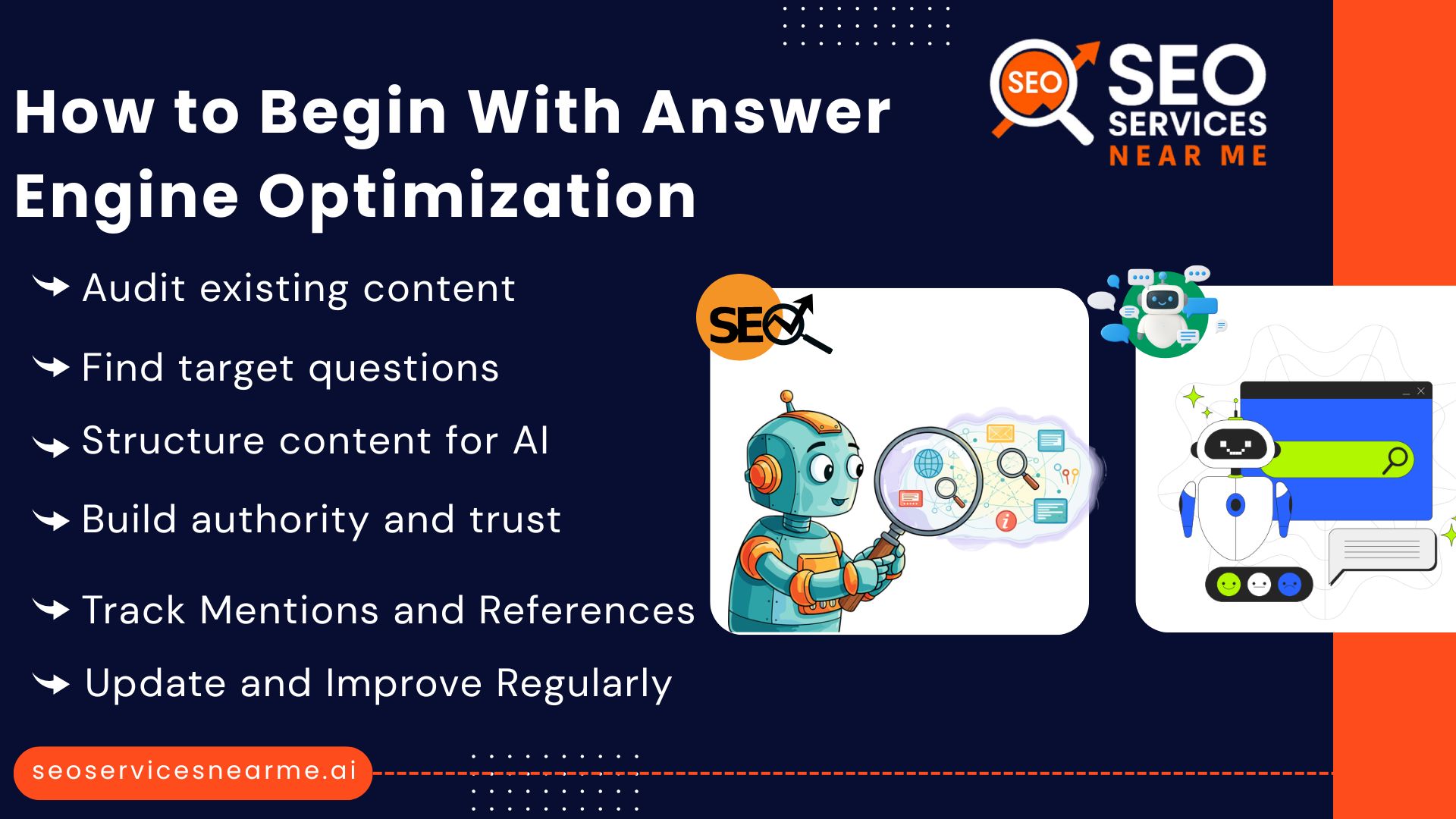
Initially, it might be overwhelming for you to start with AEO, but by following these steps, you can effectively handle the process
First, examine your current content to identify pages that already answer common questions. You can use search queries or AI tools to see if your content is being cited by AI platforms.
Next, make a list of questions your audience frequently asks. You can use tools like ChatGPT, Perplexity, and Quora because they will help you identify real user queries that the content you prepare should address.
After that, organize your content so AI can easily understand and reference it. You should use clear headings that directly answer questions, provide concise summaries, and add structured markup like schema for FAQs, How-To guides, or Q&A sections.
Make sure your content is trustworthy by citing reliable sources and keeping accurate and up-to-date information. Generally, AI tools will prioritize authoritative content over promotional material.
Monitor where your content is being mentioned or cited by AI tools. You can use specialized platforms or manual checks to track performance and adjust your content accordingly.
Continuously refine your content to address new questions and adapt to changes in AI algorithms. Regular updates and consistency are essential for long-term success with AEO.
AEO does not provide immediate results. Mostly, depending on your website’s current SEO status and the extent of your optimization, you may start seeing results in a few weeks, or it could take several months.
Websites with a strong SEO foundation usually achieve AEO results more quickly because they are already discoverable and trusted by search engines. If your SEO is new, focus on building that foundation first, then add AEO strategies on top.
As AI-powered tools become the main way users search, brands need content that is not just online but cited in AI-generated answers. So, AEO is essential for digital visibility in the AI era. It complements SEO by helping brands appear in AI-generated answers and keeping them visible as search shifts from links to conversations. Use our AI SEO services to apply SEO or AEO to your website. We offer proven strategies to position your brand as a trusted source in the new era of online search.