To calculate SEO ROI, track your total SEO investment and the revenue generated from it. Use the formula ROI = (Revenue – Cost) ÷ Cost × 100. This shows how much profit SEO brings and helps guide future strategy.
In today’s digital world, SEO is a long-term investment that can bring steady, high-quality traffic to your website. But after implementation, it is common for you to wonder whether your SEO efforts are actually paying off. If you want to find out the answer to this doubt, then you must calculate the Return on Investment (ROI). Unlike quick tactics such as paid ads, SEO takes time to show results, usually three to six months. So, you need to track both your efforts and the results carefully. Generally, understanding how to calculate your SEO ROI will help you justify your marketing budget and make smarter, data-driven decisions to improve your strategy over time. If you are clueless about how to measure your SEO Investment returns, follow the steps suggested in this blog.
SEO ROI measures the financial return your business earns from investing in SEO activities compared to what you spent on those efforts. It is typically expressed as a percentage that demonstrates value beyond the cost. In other words, if you invest in improving your website and content, SEO ROI tells you how much revenue that investment brings back.
SEO ROI can differ from business to business, and there is limited data on average returns. Still, nearly half of 49% marketers say organic search delivers the highest returns compared to other marketing channels. In addition, organic search is responsible for about 40% of overall business revenue.
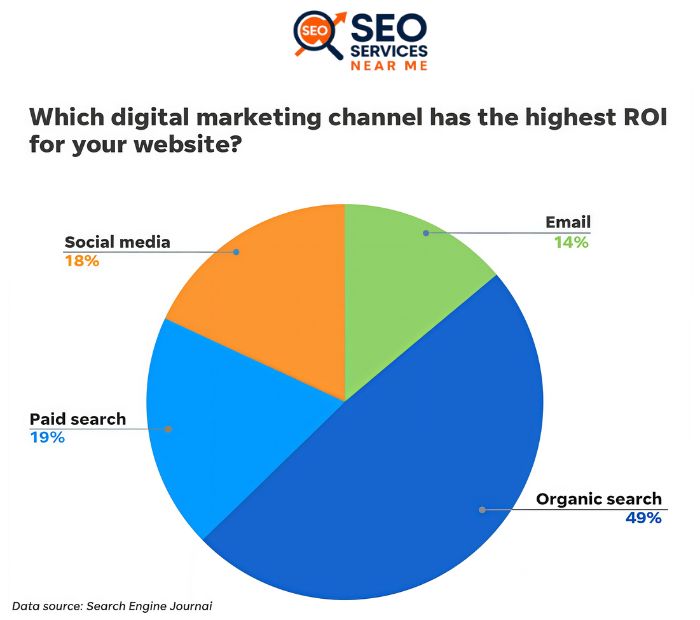
This data shows that SEO can consistently deliver a return on investment. However, the amount you get back depends on how much you invest and how wisely you use your SEO budget.
Here’s the core formula marketers use to calculate the ROI of SEO
ROI = (Gain from Investment – Cost of Investment) / Cost of Investment × 100
If you want to calculate the ROI, take the gain from your SEO investment, subtract what you spent, divide that by your investment cost, and then multiply by 100. This will give you a clear percentage that shows your return.
If you track your SEO ROI too early, the results can be misleading because your SEO strategy needs time to gain traction and show real impact. Furthermore, reviewing the data within a shorter timeframe can give an incomplete picture and lead to undervaluing your work or making poor decisions.
Therefore, measure your ROI only after at least six months of consistent effort. During this time, SEO gradually improves rankings, attracts organic traffic, and converts visitors into customers.
If you want to know the real impact of your SEO efforts, then you must measure the ROI. By regularly calculating your SEO ROI, you can understand what is working and what needs improvement. Specifically, you can
Measuring SEO ROI isn’t always easy. Here are some common challenges you might run into
There isn’t a single “good” ROI that works for every business. Your results will depend on factors like your industry, the cost of services, the value of your conversions, and how many keywords you track.
Some companies spend anywhere from $2,500 to $7,500 per month on SEO, and sometimes even more. So, instead of trying to match these numbers, focus on setting realistic goals for your business and tracking your performance over time.
If you want to calculate the ROI of your SEO efforts, then follow these steps
First, you need to understand how much you are spending on SEO. Your SEO costs include:
| Types of SEO Expense | Examples |
| SEO tools | Ahrefs, SEMrush, Moz |
| Outsourced services | SEO agency, freelancers |
| In‑house team salaries | Content writers, SEO specialists |
| Content & link building | Guest posts, blogs |
After adding up all these costs for a specific period, like a month or a quarter, you will know your total SEO investment.
Tracking revenue from SEO can be tricky, especially if your business is lead-based, like a service company. Even so, you can still measure how your SEO efforts are impacting your revenue.
There are two common ways to track SEO revenue.
After figuring out your SEO costs and the revenue it brings, apply this formula:
SEO ROI = (Gain from Investment − Cost of Investment) / Cost of Investment × 100
Example
For example, if a business spends $5,000 on SEO and earns $50,000 in profit from it:
Cost of Investment = $5,000
Gain from SEO Investment = $50,000
ROI = (50,000 − 5,000) / 5,000 × 100 = 900%
900% ROI means every dollar spent earned 9$ in return.
While ROI is important, it is not the only way to see how your SEO is doing. You should also keep an eye on:
Usually, tracking these Key Performance Indicators (KPIs) will give you a clear picture of how well your SEO is performing.
If your SEO ROI is poor, try these actions to improve it:
Calculating the ROI of your SEO campaign goes beyond mere numbers. It will enable you to determine how your campaign fares as well as optimize it. Moreover, with your spending, conversions, and revenue in one equation, you can analyze how your business fares with SEO. Even when SEO takes a while to yield a return on your investment, your ROI analysis will bring clarity to which areas of your campaign are profitable. If your business is struggling to achieve the desired profit, consider utilizing our AI-powered local SEO services. Our SEO expert team will help you grow your business and yield more revenue by implementing proven tactics.
You should calculate your SEO ROI every month, every few months, or once a year. This helps you track progress and adjust your strategy as needed.
Yes, SEO ROI can be negative if the money spent on SEO is more than the revenue it brings in. This means it may be time to review your strategy, reduce costs, or work on improving conversions.
Tools such as Google Analytics 4 (GA4), Ahrefs, Semrush, and other analytics platforms can track costs, traffic, and conversions. These insights are important for calculating SEO ROI accurately.