Select a domain that is concise, easy to recall, and accurately represents your brand. Use relevant keywords wisely, avoid special characters, select the right TLD, and ensure it remains flexible for future growth to support SEO.
A domain name is more than just a website address. It will help you shape your brand and can also affect how people and search engines see your site. Even though domain names do not directly impact rankings as much as they once did, choosing the right one is still important for SEO. A good domain will support better visibility, trust, and user experience. If you are clueless about how to choose the best domain name for SEO, read this blog. Here, you will learn what domain optimization means, why a domain name matters, and how to choose an SEO-friendly domain name smartly.
A domain name is the unique address that people type into their web browser to visit your website. (For example: https://www. abc.com). A domain has two main parts. They are the top-level domain (TLD) and the second-level domain (SLD).
TLD refers to the extension, such as .com, .org, or .net, present at the end of the domain name. The second-level domain (SLD) is the primary part of the domain name that comes before the TLD and shows the website’s identity.
Especially, by using a good domain name, brands can build trust, explain what their site is about, and create a better experience for visitors. Domains also play a small but meaningful role in SEO.
Choosing the right domain name is important for several reasons. Particularly, it can affect your website’s user experience (UX), which is an important factor for SEO. A short and memorable domain will make it easier for users to type, remember, and share your site. When your domain clearly reflects your business or industry, visitors can quickly understand what your website is about, improving their experience. Additionally, a simple and relevant domain reduces mistakes or confusion, leading to better UX and stronger SEO results. While almost any domain can rank with quality SEO services, having a well-chosen domain will make the process easier and more effective over time.
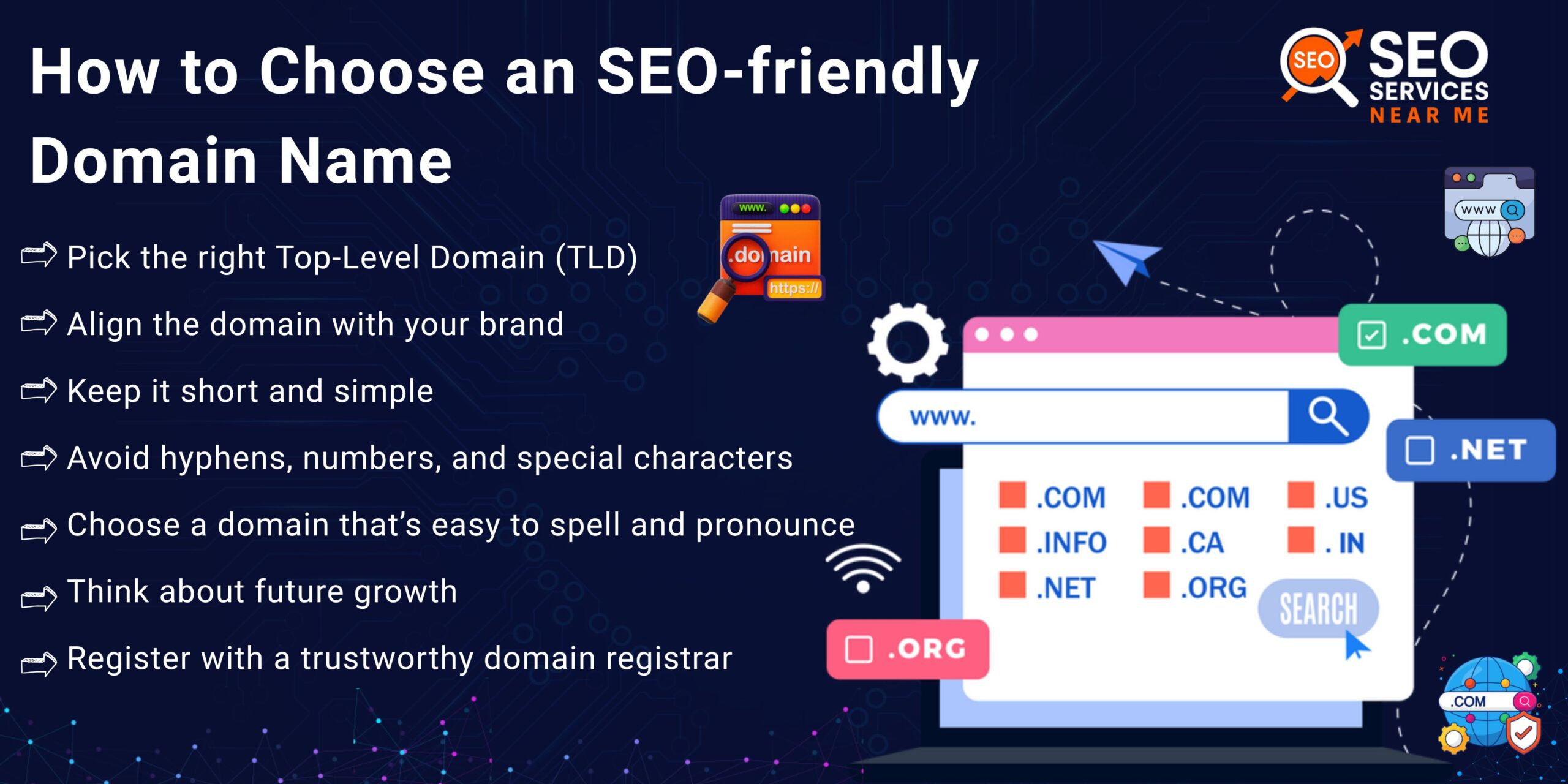
Are you wondering what domain name to choose for your brand? Do you have no idea how to find an SEO-friendly domain name? If yes, follow these steps for selecting a domain name
When choosing a top-level domain or TLD, pick an extension that fits your target audience and supports your website’s goals. Some popular TLD options include .com, .org, .edu, .gov, .net, .ca, .ai, .store, and .io. Also, consider where your audience is located and who they are. If your business mainly serves a specific country, a country-specific TLD like .us or .uk can be a good choice. For a global audience, a general TLD like .com or .net is usually better.
Additionally, think about your type of organization. Nonprofits may benefit from an .org to show their mission, while educational sites can gain credibility with an .edu extension. Remember, choosing the right TLD will help reflect your brand, values, and goals while improving your site’s reputation online.
Including a relevant keyword in your domain name can be helpful, but it is not required. The main goal is to choose a domain that fits your brand rather than cramming in keywords. For example, a bakery called “Sweet Treats Co” could use a domain like “sweettreatsco.com,” which includes the phrase “sweet treats” to show what the business offers while keeping the brand unique.
Before picking a domain, do keyword research to find popular and relevant terms for your industry. Then, select the one that best describes your business. Make sure any keyword you use is simple, easy to remember, and short. Adding location-based keywords, like “nycbakery.com,” can also help attract local customers and set your business apart from nearby competitors.
Short and simple domain names are easier for users to remember and type into their browsers. So, keep your domain under three words and avoid numbers or hyphens, which can confuse visitors. Better choose a name that clearly reflects your business or website to build trust and attract the right audience.
For example, a fitness blog could use “FitLifeTips” or “StrongBodyGuide,” which clearly indicate the website’s focus. A generic name like “Blog123” doesn’t give users any idea of the content. Therefore, pick a domain that is both memorable and descriptive to help increase traffic and engagement.
Never use numbers, hyphens, or other special characters in your domain name. They might seem like a way to make your domain stand out, but they can make it harder for people to remember or type correctly.
For example, a domain like “Healthy-Eats-24” could confuse users who forget the hyphens or mistype the numbers. This can lead to lost traffic. So, it is better to choose a short, simple, and easy-to-remember domain without any special characters or digits.
When you choose a domain name, make sure it is easy to say and spell. If people find it hard to pronounce, they may struggle to remember or share it. Similarly, a complicated spelling can make it difficult for visitors to find your site, or they might end up on a different website by mistake. Pick a domain that is simple to speak and type to avoid confusion and make it easy for users to reach you.
Even if your business has a specific focus, choose a flexible domain that allows for future growth or changes. Experts recommend focusing on your brand rather than specific keywords because your website will likely evolve. But choosing a general domain will keep it relevant as your business grows.
For example, a bakery called “Emma’s Cupcake Corner” might use “Emma’s Bakery” as a domain. This will give the business room to offer breads, pastries, and other baked goods later on.
Once you choose a domain that fits your business and allows for future growth, you will need to register it with a reliable domain registrar. Registering your domain will ensure it legally belongs to you and will prevent others from using it. You should select a trusted registrar that will offer good service and support, and make sure their prices and renewal fees will fit your budget. Registering with a reputable registrar will give you peace of mind and will make it easier to build your online presence.
Generally, picking a domain that is easy to remember, matches your brand, and is simple for users will give your website a strong foundation to grow. Moreover, when combined with good content, user-friendly design, and effective SEO practices, the right domain can help your site reach more people and build a strong online presence for years to come. Hire the best SEO experts from our team if it is challenging for you to identify a good domain name that can boost your brand’s visibility.
Google doesn’t consider domain names as a major ranking factor, but a good domain can build trust and influence how users interact with your site. This can indirectly help your SEO.
Yes, switching your domain can temporarily lower your search rankings unless you use proper redirects, such as 301 redirects, to maintain your links and traffic.
Including keywords in a domain used to help SEO a lot, but now it mainly helps with branding and clarity. Avoid stuffing keywords, as it can look spammy and reduce trust.