The discussion on traditional vs. AI SEO will help you find the best approach for your business. AI SEO offers speed and scalability, while traditional SEO provides control and human insights. But together, they can create a more effective and balanced SEO strategy to meet the demands of 2025’s digital landscape and achieve better results.
In online marketing, getting your company noticed online is a big deal. One way to achieve that is through Search Engine Optimization (SEO). Now, in 2025, marketers discuss two ways to do SEO. You can either use a traditional SEO or an AI SEO strategy. A traditional SEO depends on human effort and experience, whereas an AI SEO depends on technology to mechanize and enhance the process. Both strategies have advantages and disadvantages. So, you may be thinking which strategy will suit your brand best in 2025. If you have the same question in your mind, then go through this blog. Here, we have outlined how traditional vs. AI SEO differ. We have also explained what each method involves and what you might choose to use for your business in 2025.
Traditional SEO refers to optimizing your website manually so that it appears higher on search engines such as Google. It involves getting the correct keywords people use and incorporating them into your content (Keyword Research). Also, as a part of on-page optimization, it entails inserting things such as Meta tags, titles, and ensuring that your content is of good quality.
Other crucial tasks involve obtaining links from other websites (Link Building) and dealing with technical problems, such as loading slowly or ensuring your website functions properly on phones (Technical SEO). SEO professionals utilize their expertise and specialized tools to analyze data, make adjustments, and measure how well the website is doing.
AI SEO uses advanced technology such as artificial intelligence and machine learning to automate and enhance SEO tasks. Mainly to optimize the content for better rankings, the AI system will analyze large volumes of data, identify patterns, and make data-driven decisions.
Also, the AI tools will play a major role in predicting the best keywords, generating topic clusters, automating technical audits, and creating SEO-rich content suitable to attract the target audience. Overall, AI will take away a lot of the guessing and manual work from traditional SEO and make the whole process faster, more precise, and scalable.
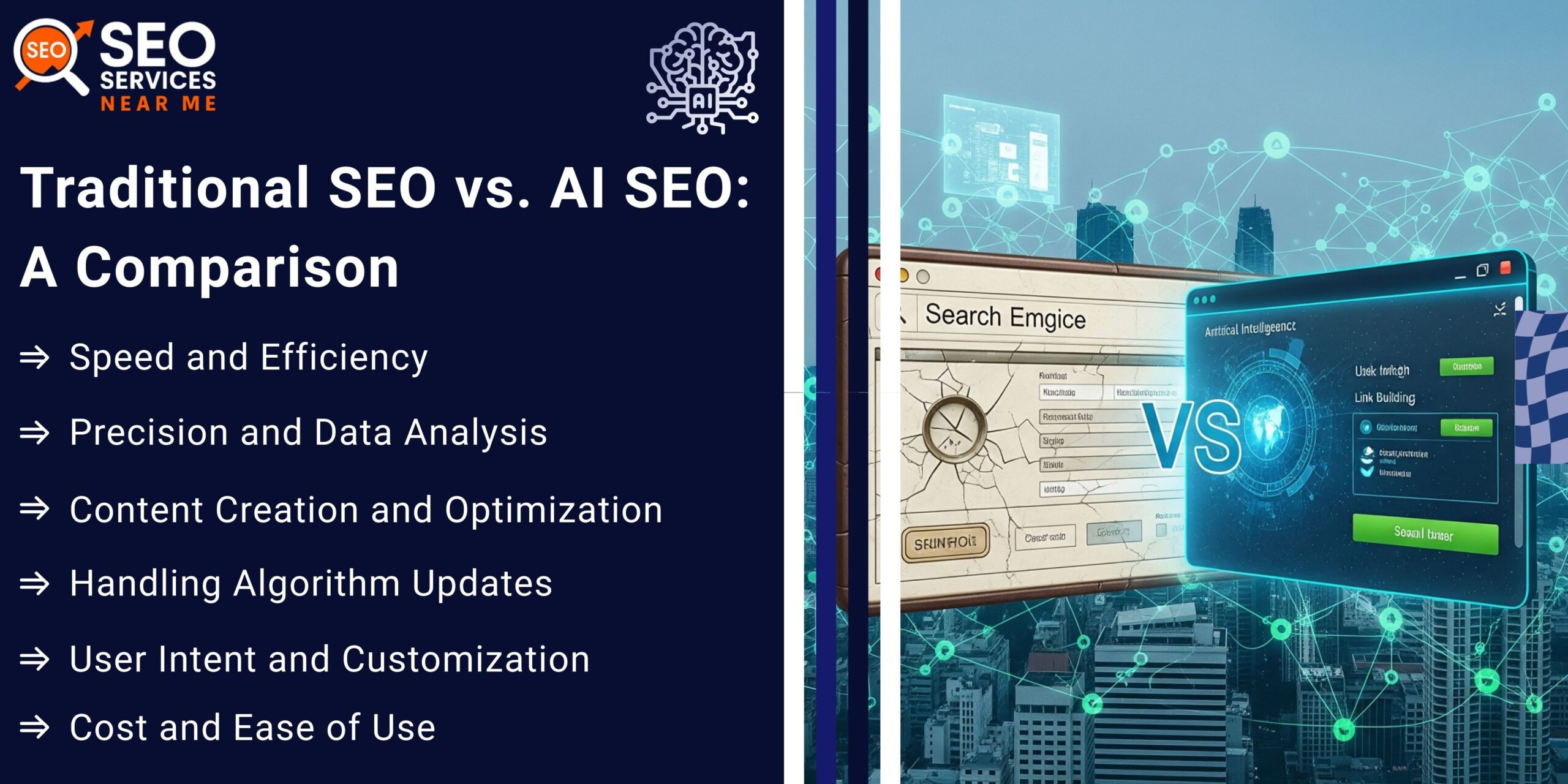
Here, let us compare traditional and AI SEO to see how they differ in key areas and which one might suit your needs better.
Traditional SEO is time-consuming because it requires hours or even days of manual effort to perform tasks, such as keyword research, content creation, and audits. In contrast, AI-driven SEO is much faster because tools like Surfer SEO, Clearscope, or Semrush Copilot can quickly analyze your content and provide instant suggestions for improvement.
Traditional SEO relies on human judgment. So, it may lead to bias or missing important patterns in large amounts of data. AI SEO, on the other hand, uses machine learning to find trends and connections that people might overlook. This, in turn, will make data analysis more accurate.
Traditional SEO depends on human writers and editors to produce quality content. AI SEO uses tools like ChatGPT, Jasper, and Copy.ai to quickly generate SEO-friendly content. However, it is still important for humans to review the content to maintain the right tone and data accuracy.
Traditional SEO relies on manual updates and strategy changes whenever Google updates its algorithm. In contrast, some AI SEO tools can quickly detect these changes by tracking ranking patterns and also automatically adjust strategies.
Traditional SEO mainly focuses on matching keywords and targeting fixed user profiles. On the other hand, AI SEO understands the true intent behind searches. As a result, it can personalize content dynamically for each user.
Traditional SEO often requires hiring experts like SEO specialists, content creators, and technical professionals, which can be costly depending on the project’s size. On the other hand, AI SEO tools may have upfront costs but can save money in the long run by automating many time-consuming tasks.
If we had to choose which is the best between traditional and AI SEO, AI stands ahead because it works faster, handles more content, and makes smart predictions. But traditional SEO still matters because it plays an important role in creating content that builds trust and tells a strong story. In 2025, the best SEO strategies don’t choose one over the other. They focus on combining both approaches to get the most effective results.
In 2025, the hybrid SEO method will work best for your business. A hybrid SEO approach focuses on combining traditional SEO methods with AI-powered tools. It majorly uses human expertise for strategy, content quality, and brand voice, while relying on AI for data analysis, keyword research, and performance tracking. Overall, this mix of approaches will improve efficiency, accuracy, and overall results.
The traditional vs. AI SEO debate is not about choosing one over the other, but about how they work best together. AI-driven SEO is fast and can handle large amounts of work, while traditional SEO will give you more control and depend on human experience. However, by combining both approaches, you can build a stronger SEO strategy for 2025. If you are unsure how to develop an AI local SEO strategy or implement an AI SEO for local businesses, call us immediately. The SEO experts from our team will offer customized AI local SEO services to transform your business into a brand.